Everybody wants to know: what's a good cost per lead?
It's the wrong question. But I'm going to answer it anyway — with real numbers — and then show you the question you should be asking instead.
I manage $200,000+ per month in Meta ad spend for real estate wholesalers and flippers across the country. I've also spent multi-seven figures on PPC, TV, direct mail, cold calling, and PPL for my own wholesale businesses. So when I give you CPL benchmarks, they're not from a blog post I read or a course I took. They're from accounts I'm actively managing and money I've personally spent.
Here are the real cost per lead benchmarks by channel for 2026, what those numbers actually mean for your business, and the one metric that matters more than all of them.
Quick Note: How We Define These Numbers
Before I throw stats at you, here's the language we use. If you've read our other content, you know this already — but it matters because most people use "lead" and "deal" loosely, and loose definitions lead to bad decisions.
Lead — someone who submitted their info expressing interest in selling to an investor for cash.
Net Lead — your sales team spoke with them. They own a home. They want to sell to an investor for cash. Confirmed.
Appointment — they have a reason to sell other than price and want to start the process in the next 30 days.
Offer — a specific number you gave the seller. Not a range.
Contract — signed Purchase and Sale Agreement.
Deal — a closing where you made money. Not when you bought it — when you got paid.
Cost per lead is only the first number in the chain. If you optimize for CPL and ignore everything after it, you'll get cheap leads that never close. I've seen it a hundred times.
2026 Cost Per Lead Benchmarks by Channel
Google PPC
| Metric | Benchmark |
|---|---|
| Cost Per Lead | $150–$400 |
| Leads to Closed Deal | 10–15 |
| Lead to Net Lead | 65% |
| Net Lead to Appointment | 70% |
| Appointment to Offer | 90% virtual / 80% in person |
| Offer to Contract | 25% |
| Contract to Deal | 60% virtual / 75% in person |
| Target ROAS | 4x |
$150/lead is the floor for statewide campaigns. $300–$400/lead is common in competitive local markets like Phoenix, Dallas, or South Florida.
The upside: PPC leads convert at 10–15 leads to a deal. That's the best conversion rate of any digital channel because these people actively searched for a cash buyer. The intent is built in.
The downside: at $150–$400 per lead, your cost per deal ranges from $1,500 to $6,000. If your average deal size is $20k, that's a 3–13x return depending on where you fall. But if your close rate dips — and I've watched this happen to a lot of operators from 2024 to 2026 — the math gets tight fast.
PPC works best with $20k+/month budgets across multiple metros and a sales team that can close 1 in 10.
Pay Per Lead (PPL)
| Metric | Benchmark |
|---|---|
| Cost Per Lead | $100–$400 |
| Leads to Closed Deal | 25–35 |
| Refund Rate | 30–40% |
| Lead to Net Lead | 65% |
| Net Lead to Appointment | 35% |
| Appointment to Offer | 90% virtual / 80% in person |
| Offer to Contract | 25% |
| Contract to Deal | 60% virtual / 75% in person |
| Target ROAS | 4x |
PPL costs look similar to PPC on the front end, but the conversion rate is worse — 25–35 leads to a deal instead of 10–15. That means your actual cost per deal is $2,500 to $14,000 depending on market and lead price.
The 30–40% refund rate is standard. That means out of every 10 leads you buy, 3–4 get refunded because they're listed properties, wrong numbers, or otherwise unqualified. You're paying for the sorting process.
PPL's real advantage is geographic precision. If you need leads in one specific county, it's the only digital option that works at that scale. But for building a consistent pipeline, it's too unpredictable to be your foundation.
Cold Calling
| Metric | Benchmark |
|---|---|
| Cost Per Lead | $25–$35 |
| Leads to Closed Deal | 45–55 |
| Lead to Net Lead | 85% |
| Net Lead to Appointment | 20% |
| Appointment to Offer | 80% |
| Offer to Contract | 20% |
| Contract to Deal | 65% virtual / 80% in person |
| Target ROAS | 5–7x with setters / 8–10x without |
The cheapest cost per lead of any channel. $25–$35 including data costs and caller wages.
But at 45–55 leads to a deal, your cost per deal is $1,125 to $1,925 — which actually looks great on paper. The hidden cost is labor. Those 45–55 leads require hundreds of dials, hours of talk time, and months of follow-up. If you factor in fully loaded labor costs (setters, managers, CRM tools, data subscriptions), the real cost per deal is significantly higher.
Cold calling is the best channel for operators with less than $3–5k/month to spend on marketing. It's also the hardest to scale past $10–15k/month without a full setter team infrastructure.
Direct Mail
| Metric | Benchmark |
|---|---|
| Cost Per Lead | High (varies by list, volume, and mail piece) |
| Leads to Closed Deal | 3–6 |
| Target ROAS | Highly variable |
I'm including direct mail because it's still a major channel, but the benchmarks are harder to standardize because there are so many variables — list quality, mail piece type, geographic density, follow-up process.
What I can tell you: the leads that come in from mail are extremely motivated. One of my buddies recently spent $40,000 on mail, got 16 leads, and locked up 6 contracts. 1 in 3 leads to a contract. You won't see that from any other channel.
The cost to test and dial in is the barrier. You need $30–40k set aside just for the testing phase. If you're a flipper with the capital to absorb that, direct mail is one of the most scalable channels long-term. For most wholesalers starting a new channel, it's too capital-intensive to learn on.
Facebook (Meta) Ads
| Metric | Benchmark |
|---|---|
| Cost Per Lead | $20–$120 |
| Leads to Closed Deal | 15–20 |
| Lead to Net Lead | 65% |
| Net Lead to Appointment | 40% |
| Appointment to Offer | 90% virtual / 80% in person |
| Offer to Contract | 25% |
| Contract to Deal | 60% virtual / 75% in person |
| Target ROAS | 5–7x local / 8–10x+ multi-state |
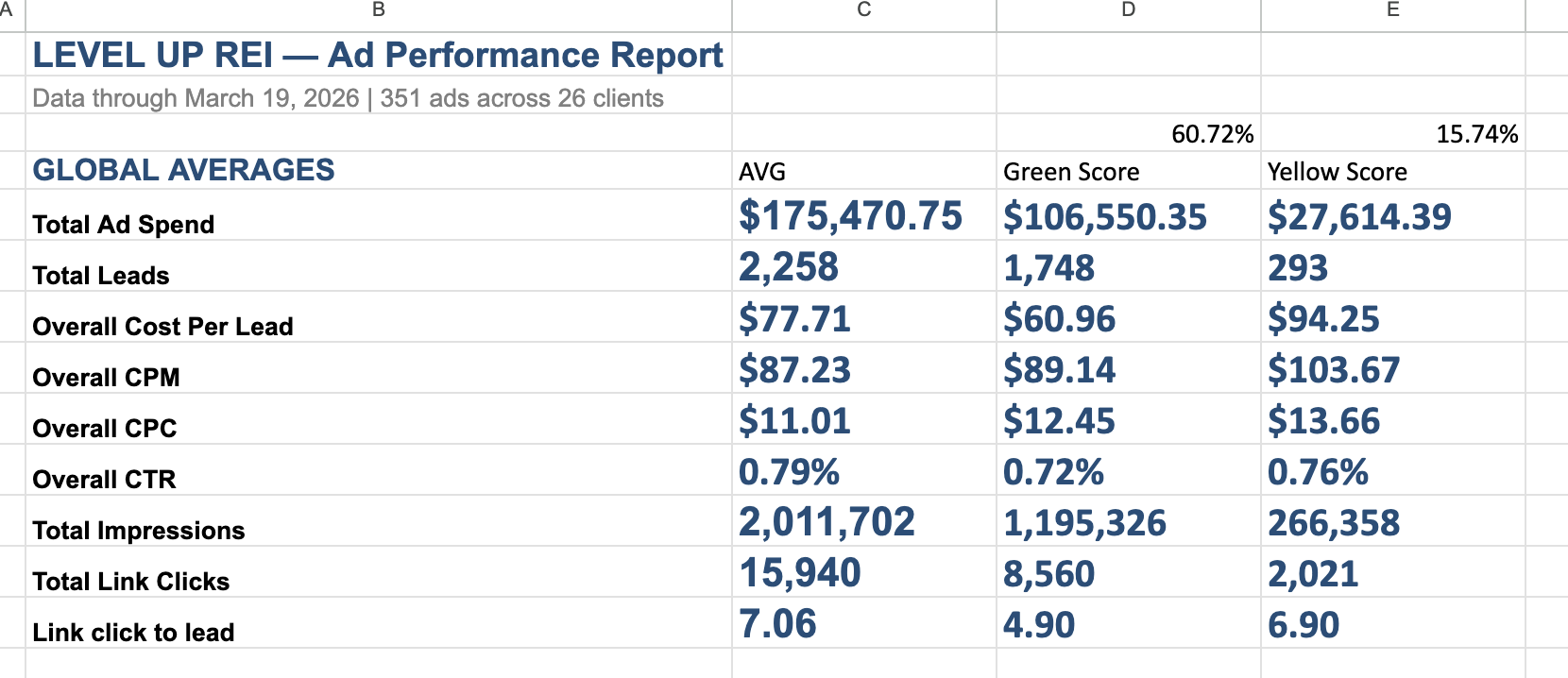
Here's our actual March 2026 data. Not projections. Not cherry-picked. This is across 26 client accounts, 351 active ads, and $175,470.75 in total managed ad spend:
- $77.71 average cost per lead
- 2,258 total leads generated
- $60.96 CPL on our top-performing ads (60.72% of ads scored "green")
- $94.25 CPL on underperforming ads (15.74% scored "yellow")
- $11.01 average cost per click
- 0.79% average CTR
At $77.71 CPL and 1 in 15 to 20 leads to a contract, that's a cost per contract of $1,165 to $1,554. Our best client right now is converting at 1 in 6 leads to a contract — putting their cost per contract at $466.
On a $20k average deal size, that's a 13–17x return at the average, and 43x for our best performer. Even at the worst end — 1 in 25 leads at $94 CPL — the cost per contract is $2,350, which is still an 8.5x on a $20k deal.
CPL by market size (what our clients actually see):
- Fully nationwide: $20–$25/lead
- Top 100 cities: $35–$40/lead
- Atlanta: $60–$80/lead
- Central Florida: $60–$80/lead
- California: $75–$90/lead
- New York / New Jersey: $80–$100/lead
- Denver: ~$100/lead
- Smaller metro (2M pop): ~$100/lead
Population drives everything. The bigger your total addressable market, the more pockets of distressed sellers Facebook can find, and the cheaper your leads get.
The Metric That Matters More Than Cost Per Lead
Look, I don't care if your cost per lead is $30 or $300. What I care about is two things:
- Your cost per deal
- How efficiently you got there
What I'm always trying to do — for myself and for every client — is get the cost per deal as low as possible AND get the leads-to-deal ratio as low as possible. Because the goal is simple: make the most amount of money with the least amount of effort.
Here's what I mean.
Cold calling is cheap. $30 a lead. But it takes 50 leads to close a deal. That's $1,500 cost per deal, which is solid. The problem is the work it takes to get there — hundreds of dials, months of follow-up, a full setter team, and a ton of grinding through conversations with people who didn't ask to be called. The cost per deal looks great on paper, but the effort per deal is the highest of any channel.
PPC is efficient. $250–$300 a lead, but it only takes 10–15 leads to close a deal. Your team works fewer leads, the people calling you already want to sell, and the cash conversion cycle is shorter. The downside is your cost per deal is $2,500–$4,500, which eats into your margins — especially if you miss a deal or two.
Facebook blends the best of both.
You get cost per lead closer to cold calling ($50–$100 range for most markets) with a leads-to-deal ratio closer to PPC (15–20 leads to a deal). That gives you a cost per deal of $1,000–$2,000 AND your team is only working 15–20 leads to get there instead of 50.
That's the real reason we're all in on Facebook. It's not just because the CPL is low. It's because it combines the affordability of outbound channels with the efficiency of inbound channels. Your team closes more deals with less work, your cash conversion cycle is shorter, and the ROI math works at almost every budget level.
Cold calling is great because it's cheap. PPC is great because it's efficient. Facebook is the best because it blends the two together.
And to be clear — cost per deal is still not the only thing that matters. What matters is ROI — dollars out divided by dollars in. Let me run the full math for each channel:
Cost Per Deal = Cost Per Lead × Leads to Deal
ROI = Average Deal Size ÷ Cost Per Deal
The ROI Math Side by Side
Google PPC (mid-range: $275 CPL, 12 leads to deal)
- Cost per deal: $3,300
- Leads your team works to close 1 deal: 12
- At $20k avg deal size: 6.1x ROI
- At $30k avg deal size: 9.1x ROI
PPL (mid-range: $200 CPL, 30 leads to deal)
- Cost per deal: $6,000
- Leads your team works to close 1 deal: 30
- At $20k avg deal size: 3.3x ROI
- At $30k avg deal size: 5x ROI
Cold Calling (mid-range: $30 CPL, 50 leads to deal)
- Cost per deal: $1,500 (before labor — add setter wages, data costs, CRM tools, and management time)
- Leads your team works to close 1 deal: 50
- At $20k avg deal size: 13.3x ROI (but highest workload per deal by far)
- At $30k avg deal size: 20x ROI (but highest workload per deal by far)
Facebook — local single metro (mid-range: $80 CPL, 18 leads to deal)
- Cost per deal: $1,440
- Leads your team works to close 1 deal: 18
- At $20k avg deal size: 13.9x ROI
- At $30k avg deal size: 20.8x ROI
Facebook — multi-market (mid-range: $50 CPL, 18 leads to deal)
- Cost per deal: $900
- Leads your team works to close 1 deal: 18
- At $20k avg deal size: 22.2x ROI
- At $30k avg deal size: 33.3x ROI
Two things jump out when you look at this side by side. First, Facebook produces the best cost per deal of any inbound channel. Second — and this is the part people overlook — the leads-to-deal ratio determines how hard your team has to work for every dollar. Cold calling at 50 leads to a deal means your sales team is grinding through 2.5x more conversations than Facebook at 18 leads to a deal to produce the same result. That's not just a cost difference — it's an operational efficiency difference that affects hiring, burnout, speed to revenue, and how scalable your business actually is.
The multi-market numbers are why our top clients are running 5–10+ states. When your CPL drops to $40–$60 and your conversion rate holds at 1 in 15 to 20, the ROI math is hard to beat with any other channel.
How to Use These Benchmarks
These numbers are averages. Your results will vary based on your market, your sales team, your exit strategies, and how well your operation is dialed in.
Here's how to use them:
1. Pick your channel based on budget and business model. Under $5k/month? Cold call. $5k–$10k? Facebook in one metro or multi-market. $20k+? Facebook primary, PPC supplement.
2. Set a ROAS baseline. Decide what return you need to be profitable. For most operators, that's a 4–5x minimum. If you're above baseline, spend more immediately. If you're at baseline, spend a little more and watch the leading indicators. If you're below baseline, optimize before spending more.
3. Track the full funnel, not just CPL. If your cost per lead is great but your cost per deal is bad, the problem isn't marketing — it's somewhere in your conversion chain. Use the manufacturing line KPIs (lead → net lead → appointment → offer → contract → deal) to diagnose exactly where.
4. Give it real data before you judge. Most channels need 60–90 days of consistent data to evaluate properly. Making a decision off 2 weeks of results is emotional, not mathematical. For Facebook specifically, expect weeks 1–2 to be a testing period with higher CPL, and weeks 3–4 to stabilize as winning creatives are identified.
5. Focus on cost per deal, not cost per lead. I'll say it again because it's that important. A marketing company that brags about $30 leads but can't show you a cost per deal number is hiding something. We track cost per contract across every client because that's what actually determines if you make money.
What Our Clients Actually Experience
I could cherry-pick our best months. Instead, here's the real average across all 26 managed accounts as of March 2026:
- $77.71 cost per lead
- 1 in 15 to 20 leads to a contract (best client: 1 in 6)
- ~$2,000 cost per contract (best: ~$466, worst: ~$4,000)
- 54% of leads want to sell ASAP
- Average client retention: 19–20 months
No minimum commitment. Month to month. We earn your business every single month.
If you want to see what your specific cost per lead and cost per deal would look like in your market, book a strategy call. We'll run the math with you — your market, your budget, your business model. No pitch, just numbers.
Chandler Saine | CEO of Level Up REI
leveluprei.io
We've helped 43 companies scale to $100k/month. 100+ five-star reviews. Clients doing 20 to 300 deals per year. $200k+/month in managed ad spend across 26 accounts.
Related Articles:
- Facebook Ads vs PPC vs PPL vs Cold Calling for Real Estate Investors
- How to Get Off-Market Motivated Seller Leads That Actually Close
- Cost Per Deal vs Cost Per Lead: The Metric That Actually Matters (coming soon)
- What a $78 Cost Per Lead Looks Like When You Actually Track It (coming soon)
- How Population Size Determines Your Facebook Ad Costs (coming soon)