You're spending money on marketing. Or you're about to.
And right now you're trying to figure out which channel is going to give you the best return — not in theory, but in your actual business, with your actual team, at the budget you can actually afford.
I'm going to give you the answer based on data from managing $200,000+ per month in ad spend across dozens of real estate investor accounts, combined with running my own wholesale companies to 90+ deals per year. Not a single number in this article is rounded or hypothetical. These are real benchmarks from real accounts.
Here's the short version: Facebook (Meta) ads are producing the highest ROI for the majority of our clients right now. But "best" depends on your budget, your team, and your market. I'll break down exactly where each channel wins and loses so you can make your own call.
Before We Get Into the Data: The Metrics That Matter
If you're going to compare marketing channels, you have to speak the same language. These are the metrics we use to audit every channel, every account, every week. This is how we know if marketing is working — and if it's not, exactly where the breakdown is happening.
Lead — anyone who shows interest in selling to an investor for cash. A hand raise. An opt-in. Someone who submitted their info.
Net Lead — a lead your sales team actually spoke with, and they confirmed: they do own a home and they want to sell it to an investor. This is a sales-qualified lead.
Appointment — a phone or in-person conversation with someone who has a reason to sell their home other than just price, and they want to start the process in the next 30 days.
Offer — a specific number you gave the seller to purchase their house. Not a range — a real number.
Contract — a Purchase and Sale Agreement signed with the seller.
Deal — a closing. The moment you actually made money on the sale of a house. Not when you buy it — when you get paid.
Average Deal Size — how much you make per closed deal.
Your business is a manufacturing line. Money goes in at the top, leads flow through each stage, and deals come out the bottom. If you're not tracking the conversion rate at every single stage, you're making emotional decisions about your marketing instead of mathematical ones. And that's why most people think their marketing "doesn't work" — they don't know where the breakdown actually is.
The marketing department's job is to get your sales team on the phone with homeowners that want to sell their property to an investor for cash, who have equity, and are in your buy box. The sales team's job is to create a gap between where the seller is and where they'd like to be, and create the urgency for them to sell to you.
Both sides have to do their job. If marketing sends the right people and sales can't convert them, that's a sales problem. If sales is dialed in but the leads are garbage, that's a marketing problem. You have to know the difference.
With that framework in mind, here's how every major channel stacks up.
The Benchmarks: Every Channel Side by Side
These come from our internal client data across multiple markets nationwide, combined with benchmarks from running and scaling our own wholesale businesses.
Google PPC
- Cost Per Lead: $150–$400 ($150 for statewide campaigns, $400 for competitive local markets)
- Leads to Closed Deal: 10 to 15
- Lead to Net Lead: 65%
- Net Lead to Appointment: 70%
- Appointment to Offer: 90% virtual, 80% in person
- Offer to Contract: 25%
- Contract to Deal: 60% virtual, 75% in person
- Target ROAS: 4x (spend $1 to make $4)
Best for: Large budgets ($20k+/month) across multiple metros. If you have a really good sales team that can close 1 in 10 leads and you're in several markets, PPC is a great channel. The leads are the highest intent you'll find in digital marketing — these people typed "sell my house fast for cash" into Google. That intent is hard to beat.
The problem: It's expensive. If you're in one competitive local market, you might be looking at $300–$400 per lead. You're also competing against the biggest companies in the industry on every single lead. And if you don't have a really good sales team, deals get sniped from you because every other investor in town got that same lead from a different keyword.
PPC also takes time to ramp. Everyone says 3 to 6 months to get fully dialed in. That's a lot of capital to burn through while you're waiting for results.
One more thing: I've watched PPC ROI get worse across the board from 2024 into 2025 and 2026. Not unusable — but the quality has shifted and the cost hasn't come down to compensate. A client of mine doing $250k/month just stopped PPC completely because it was his lowest ROI channel by far. He was struggling for a 3x when his Facebook campaigns were running at 6x+.
Pay Per Lead (PPL)
- Cost Per Lead: $100–$400 ($100 for statewide, up to $400 for competitive local)
- Leads to Closed Deal: 25 to 35
- Refund Rate: 30–40%
- Lead to Net Lead: 65%
- Net Lead to Appointment: 35%
- Appointment to Offer: 90% virtual, 80% in person
- Offer to Contract: 25%
- Contract to Deal: 60% virtual, 75% in person
- Target ROAS: 4x
Best for: Supplementing your existing lead flow. If you only want leads in one small county, PPL is actually the only digital channel that will work at a reasonable price for that level of geographic specificity. It's great for that.
The problem: You have zero control over quality or quantity. The leads come when they come — maybe after hours, maybe on a Sunday, maybe three in one day and then nothing for a week. It's chaotic. You can't build a business on chaos.
The incentives are also misaligned. These companies buy leads for as cheap as possible and sell them to you for as much as possible. They're selling the same leads to multiple people. Your lead-to-net-lead rate reflects this — at 35% net-to-appointment, you're sorting through a lot more junk to find a deal compared to other channels.
PPL isn't a pillar of your business. It's a supplement. If you treat it like your main channel, you'll be frustrated constantly.
Cold Calling
- Cost Per Lead: $25–$35 (including data and caller costs)
- Leads to Closed Deal: 45 to 55
- Lead to Net Lead: 85%
- Net Lead to Appointment: 20%
- Appointment to Offer: 80%
- Offer to Contract: 20%
- Contract to Deal: 65% virtual, 80% in person
- Target ROAS: 5–7x with setters, 8–10x on smaller budgets without setters
Best for: Smaller budgets under $3–5k/month to get paid marketing off the ground. Cold calling is cheap and the targeting is precise — you pull the list, you decide exactly who gets called. No random leads from random locations.
The problem: 45 to 55 leads to a deal. That's a lot of conversations before you see money. There's massive manual labor involved. If you're one person with capacity for 100 leads a month, you're closing maybe 2 deals. Switch to a channel that's 1 in 15 to 20 leads to a deal and you can close 5 with the same lead volume.
You're also convincing people to sell who didn't ask to be called. The "why are you calling me?" friction is real and it burns out teams. The cash conversion cycle is long — it takes about 6 months of follow-up to really start making money from cold call leads.
Cold calling works. But it takes more follow-up, has longer conversion cycles, and if you don't have good automations in your CRM, your team drowns once you get past 100 leads a month.
One important distinction: with inbound channels (Facebook, PPC, PPL), when someone calls you, assume motivation and give them an offer. With cold calling, you spend more time making them prove they're motivated rather than digging into how you can help. It's a fundamentally different sales motion, and your team needs to understand that.
Facebook (Meta) Ads
- Cost Per Lead: $20–$120 ($20 for nationwide campaigns, $120 for competitive local markets)
- Leads to Closed Deal: 15 to 20
- Lead to Net Lead: 65%
- Net Lead to Appointment: 40%
- Appointment to Offer: 90% virtual, 80% in person
- Offer to Contract: 25%
- Contract to Deal: 60% virtual, 75% in person
- Target ROAS: 5–7x (local), 8–10x+ (multi-state)
The highest ROAS I've personally seen from a client is approximately 15x on $20k/month in spend. That client is in 15 to 20 states running novations and wholesale.
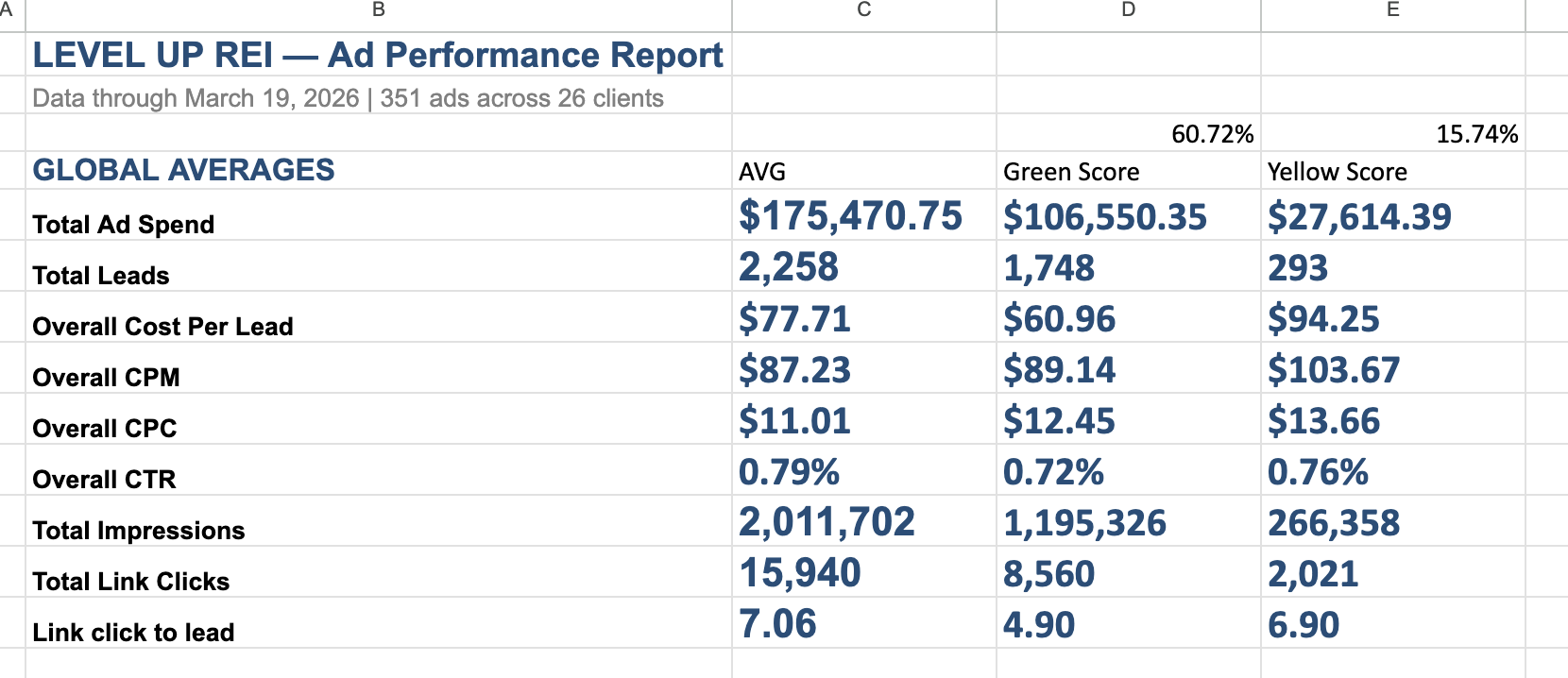
Our average across all managed clients (March 2026 data — 351 ads across 26 clients):
- $175,470.75 in total ad spend managed
- 2,258 total leads generated
- $77.71 average cost per lead
- 60.72% of ads scoring "green" (performing above benchmark)
- $60.96 CPL on our top-performing ads
- 54% of leads select "I want to sell ASAP" when they submit their info
- 1 in 15 to 20 leads to a contract on average
- Best client right now: 1 in 6 leads to contract
- ~$2,000 average cost per contract
This screenshot was pulled on March 19, 2026. We could show you a screenshot from our best week — instead, this is the real average across every client, every ad, including the ones that underperformed.
Best for: Multi-market operators, anyone wanting the highest ROI channel, and anyone spending $3k–$60k+ per month on marketing. Works in one big metro (3M+ population) or across 5–10+ states. The wider you go, the cheaper your leads get and the higher your ROI.
Why Facebook Wins on ROI Right Now
I know what you're thinking. "Facebook leads are low quality." I hear it constantly. And if you ran Facebook ads in 2023 with generic "We Buy Houses" creative and no lead filtering, you're right — those leads were garbage.
That's not what we do. Here's why the quality is different.
Pain-Focused Ad Creative
Most people run ads that say things like "Get the highest cash offer" or "Don't list with a realtor." That messaging gets cheap leads, but they're low quality — you attract curious people, not motivated sellers.
Our ads say something completely different. We talk to people who are behind on their mortgage, going through a divorce, dealing with inheritance, facing foreclosure, or drowning in medical bills. The ad specifically calls out the pain: "If you're a homeowner experiencing hardship — maybe you're behind on taxes, maybe you lost your job — we can buy your house in 7 days, cover your moving costs, and let you stay in the property after closing."
Think about who watches that ad all the way through. It's not someone in a good financial spot casually thinking about selling. It's someone who has to sell. That's why 54% of leads select "sell ASAP" on the form. The ad creative does the qualifying for you before they ever become a lead.
Lead Form Filtering
Before a lead ever hits your CRM, we filter out:
- All listed properties
- Non-owners (not the decision maker to sell)
- Unwanted property types (land, condos, commercial — whatever isn't in your buy box)
- Every lead must complete a 2-factor phone verification — they get a code texted to their phone and have to enter it to submit
That last one is huge. When we didn't verify phone numbers, about 30% were spam or wrong numbers. After implementing 2FA, our lead-to-contract ratio dropped from 30–35 leads per contract down to 20. The pixel got better data, which meant Facebook got smarter about who to show the ads to, which meant lead quality went up over time. It's a compounding effect.
The Retargeting Layer
This is the piece most people miss entirely.
We retarget three audiences:
Your CRM. All those cold call leads, SMS leads, PPC leads that ghosted you? We show them Facebook ads. They come back in as a lead through Meta, and this time they're warmer because they've already seen your brand. We close deals from people who ghosted other channels.
Website visitors. People who hit your website from SEO, PPC, direct mail, whatever — but didn't submit their info. We show them ads to capture them as leads.
Ad viewers who didn't convert. Someone watched the pain-focused ad but didn't fill out the form. We show them different angles — maybe the medical bills angle, maybe the inherited property angle — until we find the message that converts them.
This retargeting layer lowers cost per lead, increases quality, and captures deals that would have died on other channels.
The Brand Trust Campaign
After you've generated 200+ leads, we activate a brand-building layer. Every new lead automatically gets served case studies, video testimonials, and Google reviews. When your sales team calls them, they already trust you. They answer the phone. They call you back when they miss your call. They're open about their real situation instead of giving you the runaround.
Trust is at an all-time low right now. Sellers need more trust than ever before to agree to sell. The brand campaign is what bridges that gap.
The Population Math That Changes Everything
Here's something nobody else is talking about: your cost per lead on Facebook is primarily determined by population size.
This is the single most important strategic insight for choosing your market strategy.
The way the algorithm works is simple. Within your total addressable market, there are small pockets of people in each distress category — inherited property, foreclosure, divorce, tax delinquent, code violations. If your total market is 1 million people, those pockets might be 300 people each. If your market is 10 million people, those pockets are 3,000 people each.
Bigger pockets = more qualified people for Facebook to find = cheaper leads = higher quality.
Here's what CPL looks like by market size:
- Fully nationwide: $20–$25 per lead
- Top 100 cities: $35–$40 per lead
- Atlanta: $60–$80 per lead
- Central Florida: $60–$80 per lead
- California: $75–$90 per lead
- New York / New Jersey: $80–$100 per lead
- Denver: ~$100 per lead
- Smaller metro (2M population): ~$100 per lead
The multi-market strategy — running in 5 to 10 states — is what our top clients are doing right now. One client spent $100k on marketing and generated $1.5M in closed revenue. Another is doing $250k/month fully nationwide. Another is doing $300k/month in 5–7 states on $40k/month in marketing.
The key ingredients these clients use: novations, Facebook ads, and wholetails on the deep cash deals. That combination makes dispo easier because you're leveraging the MLS instead of relying solely on new cash buyer outreach.
The Honest Downsides of Facebook
I promised transparency, so here's where Facebook falls short.
It's not infinitely scalable in one market. If you're in a single metro of 2–3 million people, you're probably capping out at $10k/month in ad spend before you start seeing diminishing returns. You need more population to spend more. The math: roughly $10k in spend per 3 million people in your target area.
About 30% of leads are more rural. You can't perfectly control locations with digital marketing — this is true for PPC too. If rural leads exceed 30%, we fix it on the lead form by adding a location qualifier question. That usually solves it.
Your sales process has to be dialed in. Great leads with a bad sales process = mediocre results. Great leads with a great sales process = you crush it. If you have a great sales process with bad leads, you get okay results. You need both sides working. We help with the sales process side too — reviewing calls, optimizing scripts, coaching on conversions — because we understand that generating leads is only half the equation.
The algorithm needs active management. Facebook's job is to get the lowest cost per lead possible. Over time, it expands its targeting to broader and broader audiences, which means colder leads. If you don't stay on top of this and refresh your campaigns, lead quality degrades after 1–3 months. This is why most people say "Facebook worked for a while then stopped." They weren't managing it.
We look at every client account minimum 3 times per week. Monday: CPL update for last 7 and 30 days, plus lead quality feedback. Tuesday and Thursday: full team review of every account, creating custom ads for problem accounts, shifting budget to winning creatives. We produce 50+ new ad creatives per month across all accounts. Facebook wants new content every two weeks — if you're running the same 3 ads for 2 months, your results will die.
So Which Channel Should You Pick?
Here's the decision framework:
If you have less than $3k/month for marketing: Start with cold calling. It's the cheapest entry point and the targeting is precise. Build your pipeline, close some deals, then add an inbound channel when you have the budget.
If you have $3k–$10k/month and you're in one metro area: Facebook ads. Your CPL will be $60–$100 depending on market size, and at 1 in 15 to 20 leads to a contract, you're looking at a $1,200–$2,000 cost per contract. On a $20k average deal size, that's a 10x+ return.
If you have $5k–$10k/month and want to go multi-market: Facebook ads, no question. Your CPL drops to $40–$60, your ROI goes up, and you can scale by adding states without much additional complexity on the marketing side.
If you have $20k+/month and a killer sales team: Run Facebook as your primary channel and supplement with PPC. Facebook gives you volume and ROI. PPC gives you the highest-intent leads at a premium. Together they cover the full spectrum.
If you only operate in one small county: PPL is your best bet for digital. Cold calling and direct mail are your other options. Facebook and PPC don't target well enough at the county level to be cost-effective.
No matter what: Track your numbers. Every dollar in, every lead, every net lead, every appointment, every offer, every contract, every deal, every dollar out. If you don't know your conversion rate at each stage of the manufacturing line, you're guessing — and guessing is how you burn through marketing budgets with nothing to show for it.
The Numbers Don't Lie
I could show you cherry-picked screenshots from our best week. Instead, here's what our clients actually experience as of March 2026 — across 26 accounts, 351 ads, and $175,470.75 in managed ad spend:
- $77.71 average cost per lead (this includes good weeks and bad weeks, holiday spikes and all)
- 1 in 15 to 20 leads to a contract (best client right now is 1 in 6)
- ~$2,000 cost per contract (best is ~$1,000, worst is ~$4,000)
- 54% of leads want to sell ASAP
- 65% virtual contract-to-deal rate, 80% in-person
At a $20k average deal size and a $2,000 cost per contract, that's a 10x return on marketing spend. Even in the worst-case scenario — $4,000 cost per contract with a $15k deal size — you're still at nearly a 4x return.
If someone can prove they get better average client results than these numbers, you should work with them. But I promise you won't find that person.
We value transparency. If our systems and marketing suck for your account, we'll tell you. That's why our clients actually get results and stick around for an average of 19–20 months working with us.
No minimum commitment. No long-term contract. Month to month. We earn your business every single month.
If you want to see what your cost per lead would look like in your specific market and how this system would fit into your business, Book a Call With Our Team. We'll walk through the math with you — no pitch, just numbers.
Chandler Saine | CEO of Level Up REI
leveluprei.io
We've helped 43 companies scale to $100k/month. 100+ five-star reviews. Clients doing 20 to 300 deals per year.