If you're a wholesaler or flipper, your entire business comes down to one thing: getting off-market sellers who actually want to sell into your pipeline, consistently, at a cost that makes the math work.
That sounds simple. It's not.
You've probably tried a few things already. Maybe you're cold calling and getting 1 deal out of every 50 leads. Maybe you tried PPC and your cost per lead was $300+ with declining quality. Maybe you bought PPL leads and half of them were listed properties or wrong numbers. Maybe you hired a marketing agency that showed you great screenshots on the sales call and then delivered garbage once you signed up.
I've been on every side of this. I built a wholesale company to 90+ deals per year. I've spent multi-seven figures on marketing across PPC, TV, direct mail, cold calling, PPL, and Meta. And now my company, Level Up REI, manages $200,000+ per month in ad spend for wholesalers and flippers across the country.
Here's what I've learned: the channel matters less than most people think. What matters is the system — how you attract, filter, nurture, and convert leads. And right now, the system that's producing the highest ROI for the most operators is Facebook (Meta) ads run with a very specific strategy.
This article is the full breakdown. How we generate off-market motivated seller leads, what the real numbers look like, and how to evaluate whether any lead generation approach is actually working for your business.
First: What Is a "Motivated Seller Lead" Actually?
The term gets thrown around loosely, so let me define it the way we use it inside our business and for all of our clients.
A motivated seller is a homeowner who needs to sell — not wants to, needs to. There's a circumstance in their life that's forcing action: foreclosure, divorce, inheritance they don't want, medical bills, job loss, tax delinquency, code violations, or a property that's become a financial burden they can't maintain.
These people aren't listing with a realtor. They aren't casually browsing Zillow. They need a fast, simple solution — and that's what you provide.
The difference between a "lead" and a "motivated seller lead" is the difference between someone who clicked a button and someone who has a real problem you can solve for a real profit.
Most marketing channels give you the first type. Our system is built to deliver the second.
Here's how we measure lead quality across every account we manage:
Lead — anyone who submits their info expressing interest in selling to an investor for cash.
Net Lead — your sales team spoke with them. They own a home. They want to sell to an investor. This is a confirmed, sales-qualified lead.
Appointment — they have a reason to sell other than just price, and they want to start the process in the next 30 days.
From there, the funnel continues: Offer → Contract → Deal → Revenue. Each stage has a conversion rate. If you're not tracking every single one, you're flying blind. More on that later.
The 5 Channels for Getting Off-Market Seller Leads (And Where Each One Breaks)
Before I show you our system, here's the honest landscape. Every channel works for somebody. The question is which one works for you given your budget, team, and business model.
Cold Calling
Cost per lead: $25–$35. Leads to deal: 45–55. Best for: Budgets under $3–5k/month.
Cold calling is the cheapest way to generate leads. You pull a list, you call it, you sort through conversations until you find someone willing to sell. The targeting is precise — you choose the list.
The problem is volume. At 45–55 leads to a deal, you need a lot of conversations to close anything. Your team spends most of their time convincing people who didn't ask to be contacted. The cash conversion cycle is 6+ months because most cold call leads need extensive follow-up before they're ready to act.
It works. But it's a grind, and it doesn't scale easily without a setter team.
Google PPC
Cost per lead: $150–$400. Leads to deal: 10–15. Best for: Large budgets ($20k+/mo) in multiple metros.
PPC leads are the highest intent in digital marketing. These people literally typed "sell my house fast for cash" into Google. That intent is hard to beat, and the leads-to-deal ratio reflects it.
The problem is cost. You're paying $150 minimum per lead statewide, $300–$400 in competitive local markets. You're competing against every major operator in your area for the same keywords. And I've watched PPC quality deteriorate across the board from 2024 into 2026 — what used to convert at 1 in 10 is now 1 in 15 for a lot of operators, and costs haven't come down.
A client of mine doing $250k/month revenue stopped PPC entirely because his Facebook campaigns were running at 6x+ ROI while PPC struggled for a 3x.
Pay Per Lead (PPL)
Cost per lead: $100–$400. Leads to deal: 25–35. Best for: Supplementing lead flow, especially in small geographic areas.
PPL gives you leads without managing campaigns yourself. If you only want leads in one county, this is the only digital option that works well at that level of specificity.
The problem is control. You don't choose when leads come, how many you get, or who else is buying them. These companies buy leads cheap and sell them to multiple investors. The quality fluctuates constantly because their incentives aren't aligned with yours. Refund rates of 30–40% are standard.
PPL is a supplement, not a foundation.
Direct Mail
Cost per lead: Varies widely, but expensive to test. Leads to deal: 1 in 3 to 1 in 6 on the leads that come in. Best for: Experienced operators with $30–40k+ to test and iterate.
Direct mail is one of the most scalable channels if you can get it dialed in. The leads that respond are highly motivated, and the conversion rate is excellent. One of my buddies sent me his numbers recently: $40,000 spent, 16 leads, 6 contracts. That's 1 in 3 leads to a contract — incredible conversion.
The problem is the cost to get there. You need $30–40k set aside just to weather the testing phase. If you don't convert on the leads you're supposed to, you're very unprofitable very quickly. There's no margin for error with mail.
If you're flipping houses and you have the budget to test, mail is a great channel. For most wholesalers starting a new marketing channel, it's too expensive to learn on.
Facebook (Meta) Ads
Cost per lead: $20–$120. Leads to deal: 15–20. Best for: Multi-market operators spending $3k–$60k+/month who want the highest ROI.
This is where we focus. Not because it's the only channel that works — but because the combination of low cost per lead and high lead quality produces the best ROI for the widest range of operators.
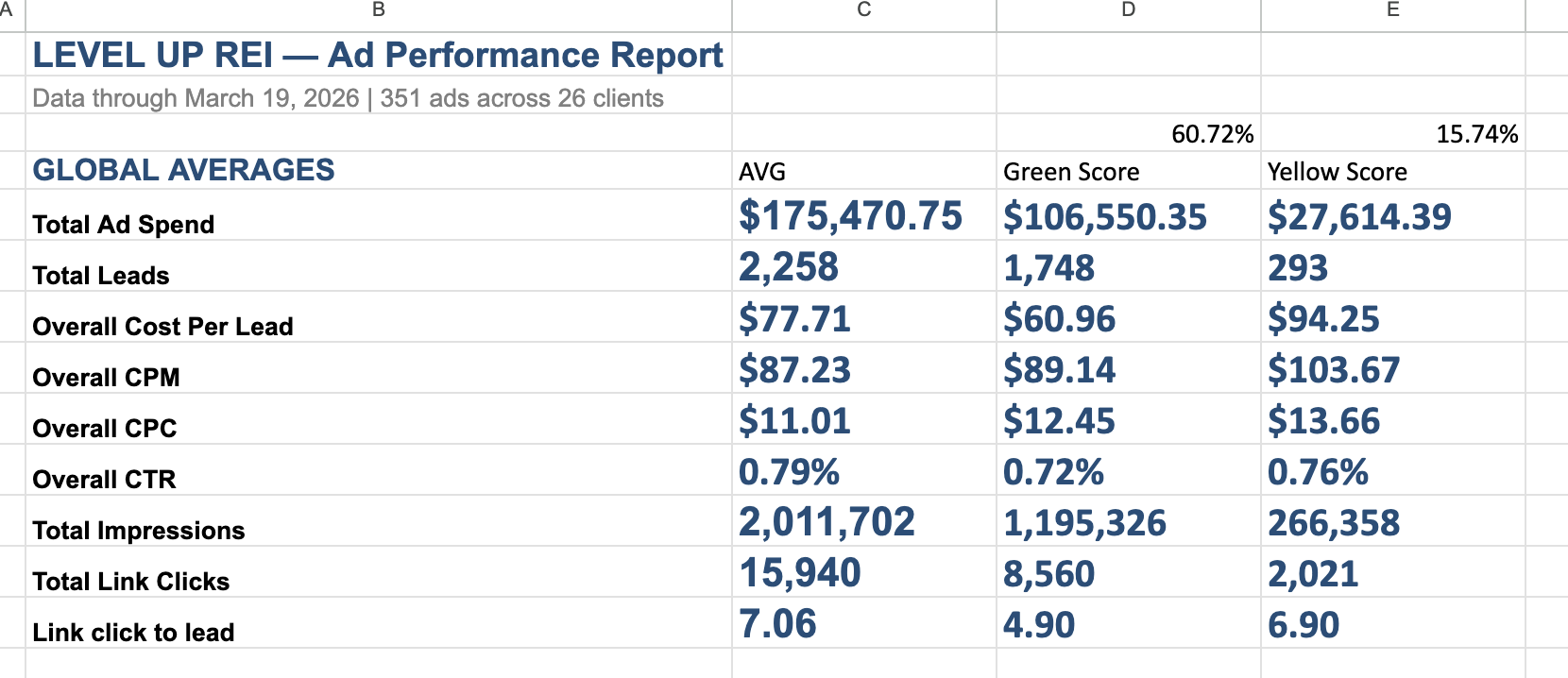
Our March 2026 data across 26 client accounts, 351 ads, and $175,470.75 in managed ad spend:
- $77.71 average cost per lead
- 2,258 total leads generated
- 54% of leads select "I want to sell ASAP"
- 1 in 15 to 20 leads to a contract on average
- Best client right now: 1 in 6 leads to contract
- ~$2,000 average cost per contract
These aren't cherry-picked numbers from our best week. This is the full picture — every client, every ad, including the ones that underperformed.
The System: How We Generate Motivated Seller Leads on Facebook
Most people who've tried Facebook ads for real estate ran a "We Buy Houses" ad, pointed it at a basic lead form, and got a bunch of unqualified garbage. That's not a Facebook problem — that's a strategy problem.
Here's the system we run for every client. There are three layers.
Layer 1: Pain-Focused Cold Ads
This is where it starts. We run video ads on Facebook and Instagram targeting all homeowners in your target markets.
But the ads don't say "get the highest cash offer" or "sell your house fast." That messaging attracts curious people — not motivated sellers.
Our ads speak directly to pain. They say things like: "If you're a homeowner experiencing hardship — maybe you're behind on your mortgage, maybe you lost your job, maybe you're going through a divorce — we can buy your house in 7 days, cover your moving costs, pay your next mortgage payment, and let you stay in the property after closing."
Think about who listens to that. It's not someone in a good financial spot who's casually browsing. It's someone who has to sell. That's why 54% of the leads that come through select "I want to sell ASAP" when they fill out the form. The ad does the qualifying before they ever become a lead.
We write ads for every distress avatar — foreclosure, divorce, inheritance, medical bills, tax delinquency, code violations, tired landlords, owner-occupants who need out. Each avatar gets its own creative. Facebook's algorithm finds the pockets of people in each category within your total addressable market and serves them the ad that speaks to their specific situation.
We produce 50+ new ad creatives per month across all client accounts. Facebook wants fresh content every two weeks. If you're running the same 3 ads for 2 months, your results will degrade. That creative production volume is a huge part of why our results stay consistent.
Layer 2: Retargeting (The Trust Layer)
This is the piece most people miss entirely, and it's what separates good results from great results.
We retarget three audiences:
Your CRM. All those leads from cold calling, SMS, PPC, PPL, direct mail — the ones that ghosted you. We upload your CRM to Facebook, show those people our ads, and they come back in as a lead through Meta. Now when you call them, they've seen your brand. They trust you. They're more open to talking. We close deals from leads that ghosted other channels constantly.
Website visitors. People who hit your website from any source — SEO, PPC, direct mail, brand searches — but didn't submit their info. We show them ads to capture them as leads.
Ad viewers who didn't convert. Someone watched the pain-focused cold ad, which means they're probably interested in selling, but they didn't fill out the form. We show them different angles — maybe the inherited property angle, maybe the "we'll cover your moving costs" angle — until we find the message that converts them.
This retargeting layer does three things: lowers your blended cost per lead, increases lead quality because you're reaching warmer people, and captures deals with less competition because these leads are coming to you instead of you chasing them.
Layer 3: Brand Trust Campaign
After you've generated 200+ leads in your pipeline, we activate a brand-building layer.
Every time someone becomes a new lead, they automatically get served case studies, video testimonials, and Google reviews through retargeting ads. We flood them with social proof.
The result: when your sales team calls, the seller already trusts your company. They answer the phone. They call back when they miss your call. They're open about their real situation — the foreclosure, the divorce, the medical bills — because they've seen other people in similar situations get helped by you.
Person-to-person trust is at an all-time low right now. Sellers need more trust than ever before to agree to sell their house to an investor. The brand campaign is what bridges that gap, and it's why our clients' leads are "more open" and "easier to talk to" compared to other channels.
What Makes Our Leads Different: The Filtering System
Generating leads is easy. Generating leads that are actually worth calling is the hard part.
Before a lead ever hits your CRM, we filter out:
Listed properties. If the property is already on the MLS, we don't let them submit. You're not competing against realtors with our leads.
Non-owners. If they're not the decision maker — not the actual owner of the property — they don't get through. No renters, no family members who can't actually sell.
Unwanted property types. Land, condos, commercial, mobile homes — whatever isn't in your buy box, we filter it on the form so you never see it.
Fake phone numbers. Every single lead must complete a 2-factor phone verification. They get a code texted to their phone and have to enter it before their info is submitted. When we didn't do this, about 30% of phone numbers were wrong or spam. After implementing 2FA, our lead-to-contract ratio dropped from 30–35 leads per contract down to 15–20. The verified numbers meant our sales teams actually reached the right people, and the cleaner data made Facebook's algorithm smarter about who to target next.
This filtering system is a compounding advantage. Better leads → better pixel data → smarter algorithm → even better leads over time.
The Population Math: Why Market Size Determines Your CPL
Your cost per lead on Facebook is primarily determined by one thing: population size.
Within your total addressable market, there are small pockets of people in each distress category. If your market is 1 million people, those pockets might have 300 people each. If your market is 10 million, those pockets have 3,000.
Bigger pockets = more people for Facebook to find = cheaper leads = higher quality.
CPL by market size (what our clients see):
- Fully nationwide: $20–$25/lead
- Top 100 cities: $35–$40/lead
- Atlanta: $60–$80/lead
- Central Florida: $60–$80/lead
- California: $75–$90/lead
- New York / New Jersey: $80–$100/lead
- Denver: ~$100/lead
This is why the multi-market strategy is what our top clients are running. Instead of spending $5k/month in one metro at $80/lead, you run 5–10 states and your CPL drops to $40–$60 while your total lead volume increases.
The key ingredients: novations, Facebook ads, and wholetails on the deep cash deals. Novations and wholetails leverage the MLS for dispo, so you don't need a massive cash buyer network to close deals in new markets.
Client results running multi-market:
- $100k in marketing spend → $1.5M in closed revenue
- $250k/month revenue — fully nationwide
- $300k/month revenue in 5–7 states on $40k/month in ad spend
If you have the systems to operate in multiple markets, the math is hard to argue with.
How We Keep Lead Quality High (When Most Agencies Let It Die)
The number one complaint I hear from people who tried Facebook ads before: "It worked for a few months and then the lead quality tanked."
Here's why that happens. Facebook's algorithm is designed to get you the cheapest cost per lead possible. Over time, it expands targeting to broader and broader audiences — which means colder and colder leads. If nobody's actively managing this and resetting campaigns, quality degrades within 1–3 months.
Most agencies set up your campaigns and then check in once a month. That's not management — that's neglect.
Here's what we do:
Monday: We send you your CPL for the last 7 and 30 days, total leads, and amount spent. We ask for lead quality feedback — not "the leads are bad," but specific feedback like "getting too many rural leads" or "seeing low equity properties" or "leads from outside my target area." That specific feedback lets us make real changes.
Tuesday and Thursday: Our entire marketing team meets and reviews every client account. We look at what's working, what's not, and create a game plan. If your CPL is high, we might film new ads with different actors matching your seller demographic, shift budget from underperforming creatives to winners, or adjust lead form questions to filter out a quality issue.
Ongoing: We grade leads A and B by which ad creative generated them. We use AI tools to analyze which ads produce the most qualified leads — not just the cheapest leads. Then we shift budget to the creatives that produce quality, not just volume.
One example: a client in Atlanta had a CPL stuck at $100. We thought it should be $75 for that market size. We filmed new ads with actors matching the seller demographic in that area, changed the creative angles, and CPL dropped to $60–$65 within a week.
We produce 50+ new ad creatives per month. We manage 351 active ads across 26 accounts. Facebook wants new content constantly — and the data from all those tests feeds back into every client's account. When we find a creative angle that works in one market, we test it across others.
This is why our average client stays with us for 19–20 months. Not because of a contract — everything is month to month, no minimum commitment. They stay because the results stay.
How to Know If Your Lead Gen Is Actually Working
Whether you work with us, another company, or do it yourself — here's the framework for evaluating any marketing channel. This is the manufacturing line KPI system we use with every client.
Track these at every stage:
Cost Per Lead → Are you getting leads at a price that makes the math work?
Lead to Net Lead (target: 65%) → Are the leads real people who own a home and want to sell?
Net Lead to Appointment (target: 35–40% for Facebook) → Are they motivated enough to have a real conversation?
Appointment to Offer (target: 90% virtual, 80% in person) → Are you making offers to almost everyone who qualifies?
Offer to Contract (target: 25%) → Are you closing a quarter of your offers?
Contract to Deal (target: 65% virtual, 80% in person) → Are your contracts actually getting to the closing table?
Average Deal Size (target: $20k+ wholesale/novation, $50k+ flip/wholetail)
If you know these numbers, you can diagnose exactly where the problem is. If your cost per lead is good but your net-to-appointment rate is low, it's a lead quality issue — your marketing team needs to adjust. If your appointments are good but your offer-to-contract rate is under 20%, that's a sales problem — your team needs training on building the gap between where the seller is and where they'd like to be.
Most people make emotional decisions about marketing. "This channel sucks." "These leads are bad." That's not useful information. What's useful is: "My lead-to-net-lead rate dropped from 65% to 50% this month, and it's because 30% of leads are coming from outside my target area." That's something you can fix.
This is what we mean when we say we're not just a lead provider — we're a fractional CMO. We're in your business looking at these numbers every week, making sure the whole system is working, not just the top of the funnel.
The Honest Downsides
No channel is perfect. Here's where Facebook falls short:
Not infinitely scalable in one market. Roughly $10k in ad spend per 3 million people in your target population. If you're in a 2M population metro, you're capping at around $7k/month before diminishing returns. You need multi-market to scale big.
~30% of leads are more rural. Digital marketing can't perfectly control geography. If rural leads exceed 30%, we add a location qualifier question to the lead form. That usually fixes it.
Your sales process has to be good. Great leads with a terrible sales process = mediocre results. We help with sales coaching, call reviews, and process optimization — but you have to be willing to put in the work on that side too.
First 2–4 weeks are a testing period. Week 1 CPL is usually $100–$150 while we test creatives. By week 2–3 we've identified winners and killed losers. By week 4 you should be in range of your target CPL. The goal in month 1 is your first contract.
What to Do Next
If you're spending $5k+ per month on marketing and you're not getting a 5x+ ROI, something in your system is broken. Maybe it's the channel. Maybe it's the lead quality. Maybe it's the sales process. Maybe it's all three.
We can tell you exactly where the breakdown is in one call. We'll walk you through what your cost per lead would look like in your specific market, what the expected lead-to-contract ratio is, and how our system would fit into your current operation.
No pitch. Just math. If the numbers work, let's move forward. If they don't, no hard feelings.
Chandler Saine | CEO of Level Up REI
leveluprei.io
We've helped 43 companies scale to $100k/month. 100+ five-star reviews. Clients doing 20 to 300 deals per year. $200k+/month in managed ad spend across 26 accounts.
Related Articles
- Facebook Ads vs PPC vs PPL vs Cold Calling for Real Estate Investors: A Data-Driven Comparison (2026)
- What Does a Motivated Seller Lead Actually Cost in 2026? (coming soon)
- Why 54% of Our Facebook Leads Want to Sell ASAP (coming soon)
- How to Filter Out Bad Leads Before They Hit Your CRM (coming soon)
- The Multi-Market Strategy: How Running 5-10 States Drops Your CPL to $50 (coming soon)